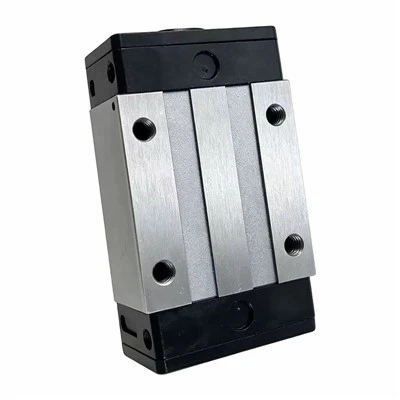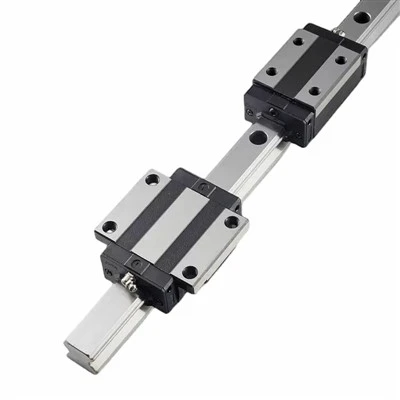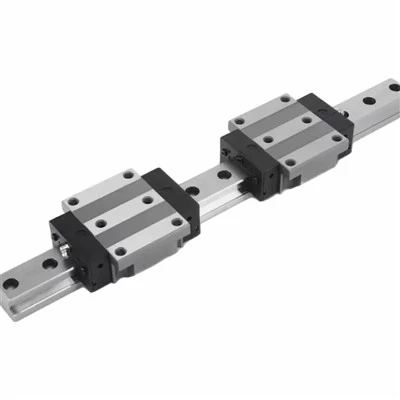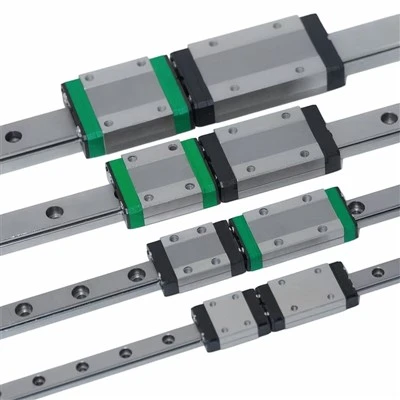
The basic assembly of a linear guide comprises components such as the rail, block, rolling elements (balls), end caps (ball return covers), side seals, and retainers; its core structure typically consists of rolling elements, raceways, a block, and sealing accessories.
Linear guides utilize rolling motion, offering smooth movement and a low coefficient of friction, while enabling seamless, effortless travel. Because the rolling elements circulate continuously between the block and the rail, the system supports linear motion of virtually unlimited length. Additionally, linear guides are characterized by high load capacity, high rigidity, high-speed capability, and high precision.
The raceways of linear guides are often designed with an R-shaped (circular-arc) groove profile. The DF (45°–45°) configuration of these grooves allows the system to absorb mounting surface irregularities through the elastic deformation of the rolling elements and the shifting of contact points, thereby providing a self-aligning capability.
The fundamental operating principle is based on rolling guidance, wherein rolling elements circulate continuously between the block and the rail, enabling a load-bearing platform to move linearly along the rail with high precision. Linear motion is achieved through this rolling element circulation mechanism.